
Income tax filing is the process of reporting your income, deductions, and tax payments to the government to calculate how much tax you owe or how much refund you should receive. In simple terms, it’s how you legally settle your tax responsibility for the year.
Yet every year, millions of taxpayers make avoidable mistakes. Wrong income reporting. Missed deductions. Incorrect forms. Filing under the wrong tax regime. These errors often lead to penalties, delayed refunds, or notices from the tax department.
The real problem is not complexity. It’s confusion.
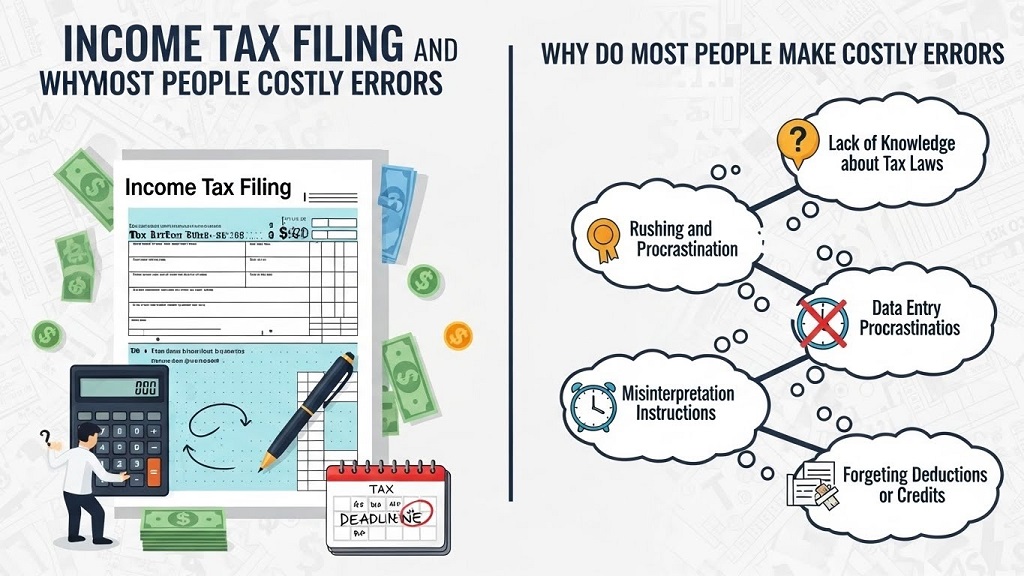
Most people don’t fail at how to file income tax because they’re careless. They fail because they rely on assumptions, outdated advice, or rushed filing at the last minute.
This guide is built to fix that.
You’ll learn how to file income tax step by step, avoid common traps, understand income tax return filing clearly, and complete your ITR filing with confidence—without fancy jargon or guesswork.
Who Needs to File an Income Tax Return?
Short answer: Anyone whose income crosses the basic exemption limit or meets specific conditions must file an income tax return.
Here’s when income tax return filing is required:
- If your total income exceeds the basic exemption limit
- If you want to claim a tax refund
- If tax has been deducted at source (TDS)
- If you have foreign income or foreign assets
- If you run a business or work as a freelancer
- If you want to carry forward losses
Even if filing isn’t mandatory, ITR filing is still beneficial. It acts as proof of income and helps with loans, visas, and financial credibility.
What Documents Do You Need Before Filing Income Tax?
Short answer: Having the right documents before you start prevents 90% of filing mistakes.
Before you begin income tax return filing, collect these:
- PAN card
- Aadhaar card (or Aadhaar enrollment ID)
- Form 16 (for salaried employees)
- Form 26AS and Annual Information Statement (AIS)
- Bank statements
- Proof of deductions (insurance, investments, donations)
- Details of other income (interest, rent, capital gains)
Case insight: In multiple tax audits, mismatches between Form 26AS and reported income were the most common reason for tax notices. Most of these errors happened because taxpayers skipped document verification.
How Do You Choose the Correct ITR Form?
Short answer: Choosing the wrong ITR form can invalidate your return.
Your ITR filing depends on your income source:
| ITR Form | Who Should Use It |
|---|---|
| ITR-1 | Salaried individuals with simple income |
| ITR-2 | Individuals with capital gains or multiple income sources |
| ITR-3 | Business owners and professionals |
| ITR-4 | Presumptive income taxpayers |
Using the wrong form is one of the most overlooked income tax filing errors—and it often leads to rejection.
How Do You Calculate Your Total Taxable Income Correctly?
Short answer: Accurate income calculation is the foundation of error-free tax filing.
Your taxable income includes:
- Salary or business income
- Interest from savings accounts and fixed deposits
- Rental income
- Capital gains from investments
- Any other taxable income
One major mistake during income tax return filing is ignoring small interest income. Banks report this data directly to the tax department, making mismatches easy to detect.
Expert note: AIS data now auto-populates most income sources. Always cross-check it before submission.
Which Tax Regime Should You Choose to Avoid Overpaying?
Short answer: The wrong tax regime can cost you more tax than required.
You can choose between:
- Old tax regime (with deductions)
- New tax regime (lower rates, fewer deductions)
The best choice depends on your deductions.
Case example: A salaried employee earning ₹8 lakh annually with ₹2 lakh in deductions saved more tax under the old regime than the new one. Many taxpayers defaulted to the new regime without comparison and paid extra.
Always calculate both options before finalizing your ITR filing.
How Do You Claim Deductions Without Triggering Scrutiny?
Short answer: Claim only genuine deductions with proper proof.
Common deductions include:
- Section 80C investments
- Health insurance premiums
- Education loan interest
- Donations
Overclaiming deductions is one of the fastest ways to attract tax scrutiny. Many notices arise from unsupported claims.
Best practice: Claim deductions only if you can back them with documents.
How Do You File Income Tax Online Step by Step?
Short answer: Online filing is faster, safer, and reduces errors.
Here’s the simplified process:
- Log in to the income tax e-filing portal
- Select the assessment year
- Choose the correct ITR form
- Verify auto-filled details
- Enter missing income or deductions
- Review tax payable or refund
- Submit and e-verify
Skipping the e-verification step makes your income tax return filing incomplete.
What Are the Most Common Income Tax Filing Mistakes?
Short answer: Small errors lead to big problems.
- Incorrect bank details
- Mismatch with Form 26AS
- Wrong ITR form
- Ignoring additional income
- Not verifying the return
These mistakes are avoidable with careful review.
How Can You Correct Errors After Filing?
Short answer: You can revise your return within the allowed timeframe.
If you notice an error after submission, file a revised return. This fixes mistakes without penalties if done on time.
How Do You Track Refunds and Respond to Notices?
Short answer: Monitor your filing status regularly.
Refund delays usually occur due to verification issues or data mismatches. Notices should be answered calmly with proper documentation.
Why Experience and Accuracy Matter in Income Tax Filing (E-E-A-T)
Tax filing isn’t just about compliance. It’s about accuracy, credibility, and long-term financial health.
Experienced taxpayers review data, verify forms, and understand rules. This experience reduces errors and avoids penalties.
Authority comes from following official guidelines. Trust comes from consistent accuracy. That’s the core of reliable income tax return filing.
Conclusion: How to File Income Tax Without Regret
Filing income tax doesn’t have to be stressful. Most costly errors come from rushing, guessing, or skipping verification.
When you understand how to file income tax step by step, choose the right ITR form, report income honestly, and verify before submission, filing becomes routine—not risky.
Take control. Review your documents. Compare tax regimes. File early.
CTA: If you want to avoid mistakes, save this guide, follow it during your next ITR filing, and file with confidence—not fear.
FAQs: Income Tax Filing
What is the best time to file income tax?
The best time is early in the filing window to avoid last-minute errors and delays.
Can I file income tax without Form 16?
Yes, but you must accurately report income using payslips and bank statements.
What happens if I make a mistake in my ITR?
You can file a revised return within the permitted time.
Is income tax filing mandatory for low income?
Not always, but filing helps with refunds and financial proof.
How long does it take to get a refund?
Refunds usually process within a few weeks after verification.
Can ITR filing be done without a CA?
Yes. Simple cases can be filed independently with proper guidance.
